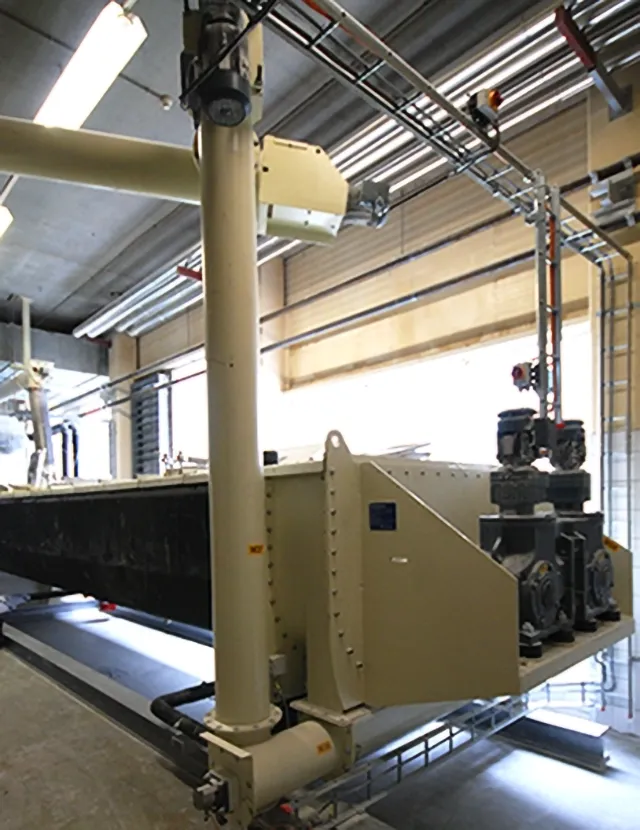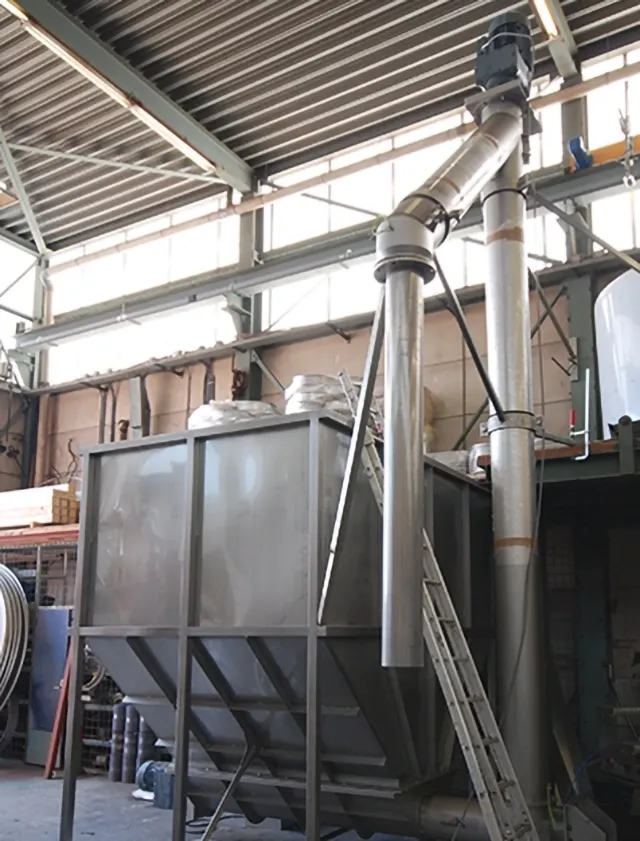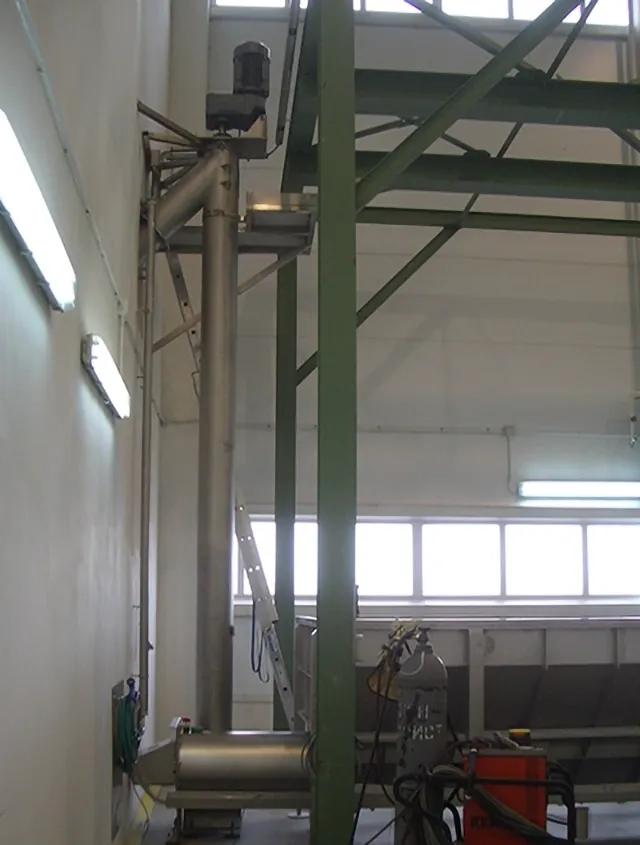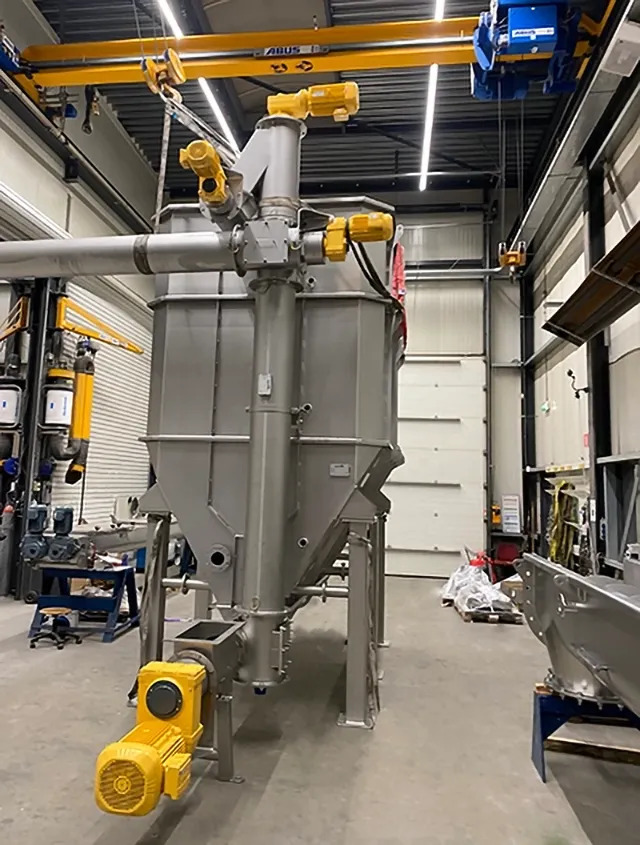
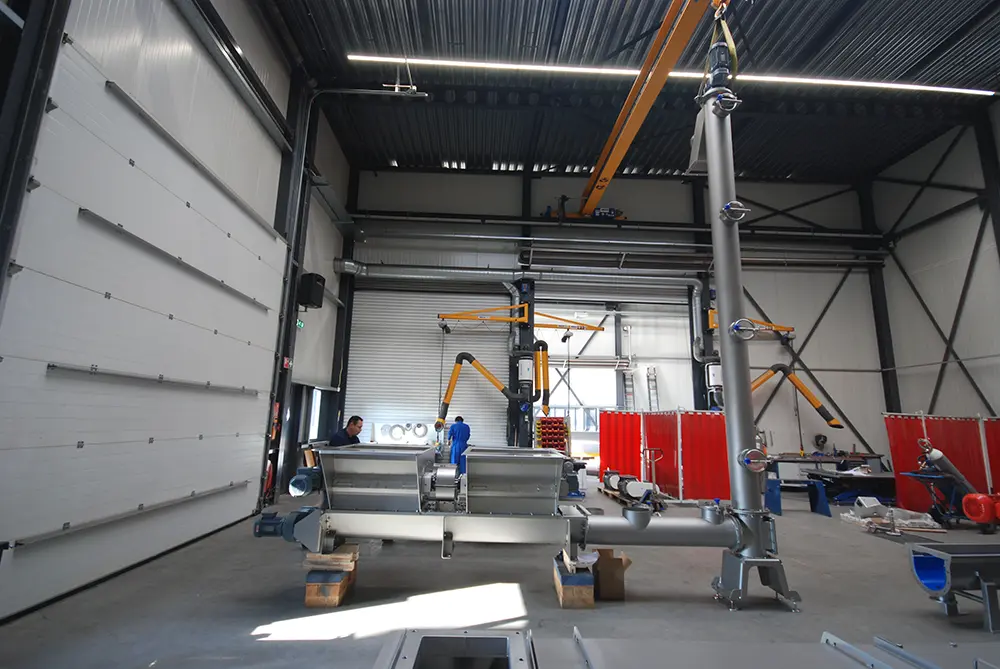
Vertical screw conveyors offer an efficient method for elevating a wide range of bulk materials—from steep inclines to fully vertical transport. Thanks to their compact design, vertical screw conveyors fit into nearly any factory layout. With a minimal number of moving parts, they provide a cost-effective and reliable component for any bulk material handling process.

  • Easily bridge height differences within just 1m2
  • Vertical cascade configurations possible
  • Efficient
  • Handles a wide variety of bulk materials
image
image

Vertical Screw ConveyorsEfficient and space-saving solutions for bulk conveying

In modern production environments where space is limited, efficiently moving bulk materials across height differences can be a challenge. Vertical Screw Conveyors offer a robust and efficient solution. With their compact design and controlled material flow, they are ideal for processes where both floor space and vertical conveying are crucial for optimizing the production environment. Traditional systems such as Bucket Elevators or pneumatic conveying often require significant space and maintenance — pneumatic conveying in particular consumes a lot of energy.

At Klinkenberg, we develop Vertical Screw Conveyors that integrate seamlessly into production environments where efficiency and reliability are essential. Our conveying systems are suitable for various industries, from the food to the chemical sector.

Icon check

Compact construction

Icon check

Requires relatively little maintenance

icon check

Simple concept

Icon check

Proven design

Options for Vertical Screw Conveyors

  • Left-oriented inlet section
  • In-line inlet section
  • Right-oriented inlet section
  • Feeding screw

The vertical screw conveyors from Klinkenberg are available in many configurations. The special inlet sections can be left- or right-oriented, or aligned directly in line with the vertical screw. To ensure maximum efficiency at the inlet, a horizontal feeding screw is required. This feeding screw delivers bulk materials directly and accurately to the vertical screw’s inlet.

Klinkenberg

How does a Vertical Screw Conveyor Work?

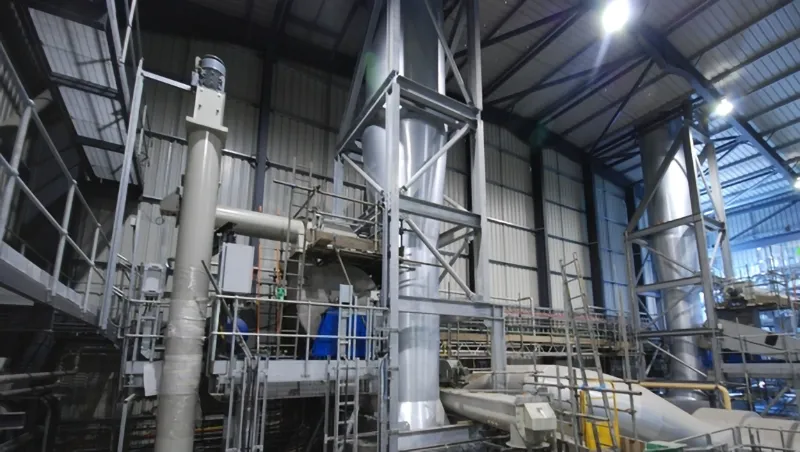
A vertical screw conveyor uses a rotating screw shaft within a cylindrical housing to elevate bulk materials in a controlled manner. As the screw rotates, centrifugal force pushes the material outward, creating an even layer along the wall of the transport tube. The screw flights then guide the product upward in an axial motion. This mechanism ensures a continuous and controlled material flow without fallback or clogging. The system is especially suitable for conveying dry and semi-fluid materials like powders, granules, and pellets—even in limited-height installations and complex processing environments.

Klinkenberg

Optimized Feed for Vertical Conveyors

Depending on the application, the system can be equipped with a feeding screw or buffer section to ensure a consistent flow to the vertical conveyor. This minimizes disruptions and prevents material build-up within the vertical screw transport system.

Klinkenberg

We are happy to help Our company is ready every day to support your critical processes.

Request a quote

Efficiency and Limitations of Vertical Screw Conveyors

Vertical screw conveyors are highly efficient for elevating certain types of bulk materials. However, due to the high operating speeds and the risk of material fallback, they are somewhat limited in terms of which materials they are best suited for.

Vertical Screw Conveyor Applications and Limitations

Vertical screw conveyors are most effective for elevating materials with the following characteristics:

  • Powdery to granular
  • Free-flowing to moderately sluggish
  • Medium bulk densities – from 160 kg/m³ to 800 kg/m³
  • Dry to low moisture content
  • Non-abrasive to mildly abrasive
  • Not brittle or easily degraded
  • Not perishable (residues may remain)

There are some exceptions to the above application guidelines. Klinkenberg's design and sales professionals can assist in addressing your specific requirements and provide the right equipment for your vertical screw conveyor.

Applied Technologies We always use the right technology for your process

Klinkenberg technology includes the following variations:

image

Technologies, Finishing and Safety

Would you like to learn more about the applied technnologies behind our screw conveyors—such as bearings, seals, safety, ATEX compliance, or the desired finish? This section provides more insights into those topics.

Discuss the possibilities Discover more

Variants

Opvoer van Zetmeelpoeder

Conveying Starch Powder

Vertical screw conveyor for discharging cooled corn starch powder. The vertical screw is fed from a Klinkenberg starch cooler and returns the material to the process for reuse.

Opvoer van cassave pasta

Conveying Cassava Paste

For a mobile cassava dryer, Klinkenberg delivered a breaker system with vertical screw conveyor in Ghana and Mozambique. The breaker crushes the cassava, and the vertical screw feeds it into the drying system.

image

Conveying Potato Flakes

Big Bags are emptied into a storage hopper to be repackaged from Big Bags into smaller packaging. The vertical screw conveyor lifts the product from the hopper high enough to feed the smaller packaging unit.

image

Conveying Crystal Sugar

At one of the world’s largest soft drink producers, multiple vertical screw conveyors were supplied for crystal sugar.
The vertical screw conveyors move the sugar from storage to the sugar dissolving tanks.

Rondloopsysteem

Recirculation System

Buffer recirculation system with vertical screw conveyor for circulating dried fishmeal powder. The vertical screw is fed from an extraction screw and partially returns the product to the drying process for reuse.

FAQ Direct answers to your questions

Quickly find answers to frequently asked questions about Vertical Screw Conveyors. Our FAQ section helps you make the right choice.

Didn't find your question?
Feel free to send us a message.

Contact us

These conveyors are suitable for a wide range of bulk materials, including powders, granules, and granular products.

The capacity depends on factors such as screw diameter, rotation speed, and the characteristics of the material being conveyed.

Yes, they can be designed with smooth surfaces and easy-to-clean components to meet hygienic standards.

Regular inspections and lubrication are generally sufficient, thanks to the robust and simple design.

Yes, they can be custom-built to seamlessly integrate with existing installations and processes.

By optimizing the design and selecting the right components, energy consumption can be minimized.

While there are practical limits, these systems can be designed to handle significant height differences, depending on the specific application.

The choice of pitch and diameter depends on the desired capacity, material type, and installation space. A smaller pitch reduces the risk of fallback, while a larger diameter increases throughput. For cohesive or high-friction materials, a customized screw geometry is often used to prevent clogging.

Excessive wear can be minimized by using heavy-duty bearings, a properly balanced screw shaft, and carefully selected speed. Additionally, lubricated or self-aligning bearings can extend the conveyor’s lifespan. For highly abrasive materials, special coatings or hardened wear-resistant components may be applied.

Although vertical screw conveyors are compact and reliable, they have certain limitations. They are less suitable for extremely high elevations compared to, for example, bucket elevators. Also, some low-friction materials may experience fallback, requiring additional design measures such as pitch adjustments, double or triple flights, or special liners inside the conveyor tube.